Category: Nigel Farage

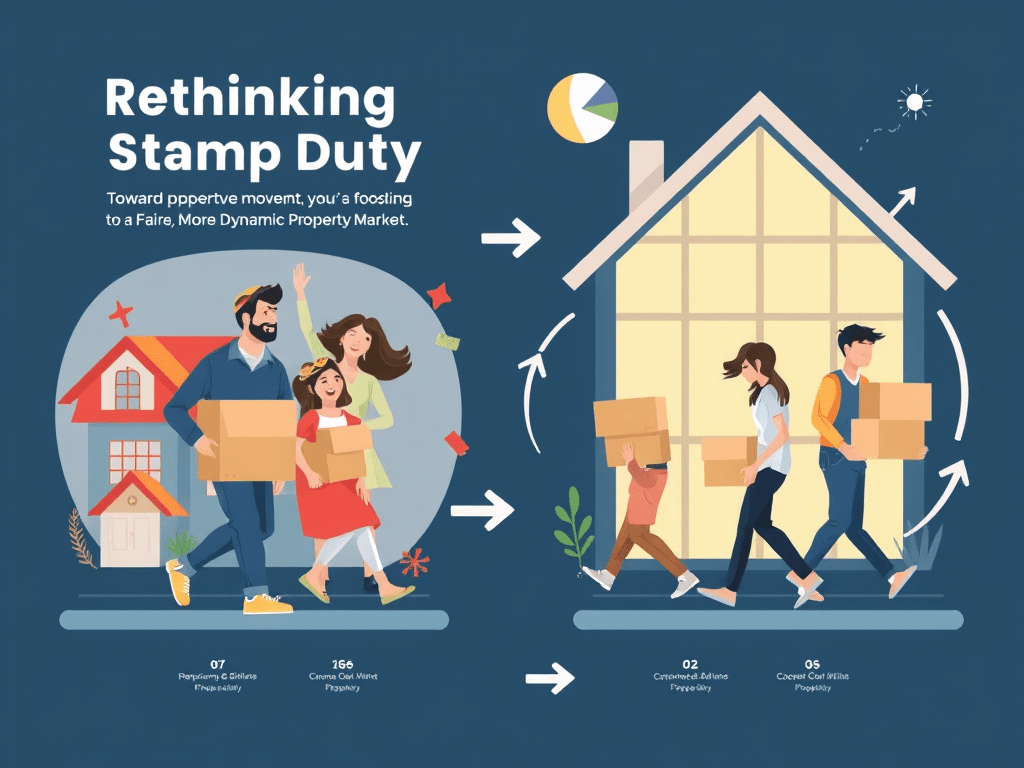
  • Stamp Duty – Pay on the difference – Rethinking Stamp Duty: Toward a Fairer, More Dynamic Property Market

    Stamp Duty – Pay on the difference – Rethinking Stamp Duty: Toward a Fairer, More Dynamic Property Market

    .

    Reading another article on how the Government is thinking of reforming Stamp Duty on Housing, I thought I would reiterate comments in a previous post, which think is a good, logical solution to stamp duty that would open up the housing market

    The Current Stamp Duty Landscape: Barriers to a Free Market

    Stamp duty has long been a sticking point for homeowners, buyers, and movers across the UK. While intended to generate government revenue, the present regime often acts as a block on the very dynamism needed for a healthy property market. In previous discussions, I highlighted the specific hurdles this tax creates—especially for the older generations, who, if able to move more freely, could release much-needed homes in popular areas for growing families.

    The rigidity of the current stamp duty regime means that those looking to downsize or relocate, perhaps to quieter, rural areas or simply to homes that better suit their needs, are often dissuaded by the financial penalty of an upfront, often considerable, stamp duty bill. Similarly, the tax can freeze out those who would otherwise consider moving for work or life changes, as they are faced with repeated payments for making necessary moves. Ultimately, this stifles the natural flow of the market, trapping people in homes that may no longer fit their circumstances.

    The New Proposal: An Ongoing Annual Tax

    One recently floated proposal suggests replacing the upfront stamp duty with an ongoing annual property charge—specifically, a tax of 0.54% per year applied to the value of any property over £500,000, but only on the amount exceeding that threshold. While this might seem progressive on the surface, it carries its own set of challenges and inequities.

    For one, this policy would disproportionately impact homeowners in the south of England, and especially in London, where property values regularly exceed the £500,000 mark even for relatively modest homes. By contrast, those in the north—myself included—are far less likely to be affected, simply due to the regional disparities in house prices. While this may seem like a boon for those of us outside the capital, the principle of fair taxation is paramount. A tax should be equitable, not geographically arbitrary.

    A New Stamp Duty Approach: Tax the Move, Not the Home

    To address these issues and unlock the property market’s potential, I propose a more dynamic, just, and effective approach: a stamp duty that applies only to the difference between the value of the property you sell and the one you buy.

    • If you “move up the ladder”—buying a more expensive home than the one you’re leaving—you pay stamp duty on the increase.
    • If you move sideways (buying at a similar price) or downsize (buying cheaper), you pay no stamp duty at all.
    • The tax would only kick in for homes over £250,000, helping first-time buyers and those with lower-priced properties avoid the tax entirely.

    A suggested rate of 5% applied to the difference would, in my view, generate at least as much, if not more, revenue for the government—precisely because it would remove the current chokepoints that suppress transaction volumes.

    Advertisements

    Breaking Down the Benefits

    • Encourages Downsizing: Older homeowners, no longer deterred by hefty stamp duty bills, would be freer to move to homes that suit their changing needs, releasing larger family homes into the market for the next generation.
    • Supports Mobility: Those whose careers require frequent moves would not be unfairly penalised by paying stamp duty multiple times on properties of similar value. Instead, tax would only apply when they actually “trade up.”
    • Boosts Market Fluidity: Removing these artificial blockers would likely increase the number of property transactions, stimulating the market and supporting related industries from removals to renovations.
    • Fairness Across Regions: By taxing only the value gained in a move, rather than the absolute price, the system becomes less vulnerable to regional price disparities. Taxpayers in high-value areas are not automatically penalised, and those in lower-value regions are not left out of the conversation.
    • First-Time Buyer Relief: Setting the threshold at £250,000 protects those entering the market for the first time, while ensuring the focus remains on higher value, higher-impact transactions.

    Practical Example

    Consider a family moving from a £500,000 house near a school to a £500,000 bungalow in the countryside. Under the current regime, they might pay as much as £15,000 in stamp duty—simply to move from one home of equal value to another. Under my proposal, they would pay nothing, as the change in value is zero. Alternatively, someone buying a second home for £500,000 without selling another property would pay 5% on £250,000 (the amount over the £250,000 threshold), amounting to £12,500.

    Conclusion: Unlocking the Market for All

    In summary, a stamp duty system based on the difference between what you sell and what you buy offers a fairer, more efficient, and economically sensible solution to the UK’s property tax puzzle. It encourages mobility, supports families at every stage of life, and reduces artificial barriers that clog up the market. Most importantly, it treats taxpayers across regions with greater equity.

    As the government considers the next phase of property tax reform, I urge policymakers to prioritise approaches that reward movement rather than punish it, ensuring that stamp duty is a catalyst for, rather than a barrier to, a more vibrant and accessible housing market for all.

    Leave a comment

  • Reforming the House of Lords: Towards a Fairer and More Representative System- #House of lords, #Reform

    Reforming the House of Lords: Towards a Fairer and More Representative System- #House of lords, #Reform

    Evaluating the Current Structure and Proposing Proportional Representation for the Upper Chamber

    The House of Lords, as the United Kingdom’s unelected upper chamber, continuously finds itself at the centre of debates surrounding democracy, fairness, and representation. Recent calls, such as those by Nigel Farage for the inclusion of peers from minor parties, have reignited conversations about the legitimacy and composition of the Lords. With the current make-up reflecting historical patterns more than present-day electoral realities, questions arise about whether the system adequately serves the modern British populace.

    The Current Composition of the House of Lords

    At present, the House of Lords comprises approximately 830 members, distributed as follows:

    • Conservative: 285
    • Labour: 209
    • Crossbench: 181
    • Liberal Democrat: 76
    • Other: 79

    This structure is a byproduct of centuries of political evolution, with life peers, hereditary peers, and bishops all contributing to a complex tapestry of backgrounds and allegiances. However, the figures above highlight a significant imbalance. The numbers of Lords affiliated with major parties do not reflect recent election results or the popular vote, but are instead the outcome of decades of appointments, retirements, and the gradual reforms that have shaped the chamber.

    Is the System Fair?

    To answer whether the House of Lords is fair, one must first define what fairness in political representation means. In a representative democracy, fairness is often equated with proportionality—the idea that the distribution of seats should, in some way, mirror the distribution of public support as expressed in elections. By this benchmark, the House of Lords falls short.

    The Lords is not elected; its members are appointed, inherit their positions, or serve ex officio. This system has preserved valuable expertise and independence, especially among crossbenchers, but it also means that party-political appointees can entrench the dominance of established parties regardless of changes in public opinion. The current composition, therefore, is heavily skewed by historical results and does not adapt dynamically to the shifting political landscape.

    While Labour currently enjoys a substantial majority in the House of Commons, twice as many people in the last general election voted for other parties than for Labour. Yet, Labour’s dominance is cemented by first past the post election result  and does not accurately represent the current political preferences of the nation.

    Disconnection from the Popular Vote

    One of the most glaring issues with the House of Lords is its disconnection from the popular vote. The 2019 General Election saw the following approximate percentages:

    • Labour: 33.7%
    • Conservative: 23.7%
    • Reform (including Brexit Party): 14.29%
    • Liberal Democrat: 12.22%
    • Others (Green, SNP, Sinn Féin, etc.): 16.9%

    The Lords’ current makeup does not reflect these numbers in any meaningful way. For instance, minor parties such as the Reform, Greens and SNP have a negligible presence, despite receiving millions of votes nationally. This lack of proportionality is not only unfair to voters who support smaller parties but also undermines the diversity of perspectives necessary for thorough scrutiny and debate.

    The First Past the Post Shortcomings

    The UK’s First Past the Post electoral system already tends to exaggerate the dominance of the two main parties in the House of Commons. Applying a similar “winner-takes-all” logic to the appointment of Lords compounds this distortion. As it stands, a party can receive a plurality of votes and yet command a disproportionate influence in both chambers. The Lords, far from acting as a corrective or counterbalance, ends up reinforcing the inequities found in the Commons.

    Moreover, the presence of hereditary peers and life appointments means that the chamber evolves only slowly, if at all, in response to public sentiment. This inertia can breed disengagement and cynicism among voters, who may feel that their views are not just under-represented in government but ignored altogether.

    A Proposal for Proportional Representation in the Lords

    To realign the House of Lords with the principles of fairness and democracy, a radical reimagining is required. One solution would be to allocate seats in the Lords according to the proportion of the popular vote each party receives in the most recent general election. Under this model, appointments would be distributed as follows:

    • Labour: 33.7%
    • Conservative: 23.7%
    • Reform: 14.29%
    • Liberal Democrat: 12.22%
    • Other: 16.9%

    If the total number of Lords were reduced from 830 to 500, the seat allocation would be:

    • Labour: 169
    • Conservative: 119
    • Reform: 71
    • Liberal Democrat: 61
    • Other: 80

    In this scenario, each party leader would be responsible for appointing individuals to fill their party’s share of seats, following the result of each general election. This would ensure that the House of Lords reflects the current political climate and the electorate’s true preferences.

    Advantages of Proportional Representation

    Adopting proportional representation for the House of Lords offers several key benefits:

    • Enhanced Legitimacy: The Lords would finally gain a clear democratic mandate, improving public trust in its role and recommendations.
    • Diversity of Thought: Smaller parties and minority viewpoints would be guaranteed a voice, enriching debates and policy scrutiny.
    • Checks and Balances: The chamber could better hold the government to account, preventing dominance by a single party and ensuring robust challenge to ill-considered legislation.
    • Cost Savings: Reducing the number of peers from 830 to 500 would significantly cut the cost of the Lords—making it more efficient and less burdensome for taxpayers.
    • Dynamic Adaptation: By reassessing appointments after each election, the House would remain contemporary and responsive to shifts in public opinion.

    -Addressing Potential Criticisms

    Some critics may argue that proportional representation would turn the Lords into a “mini-Commons,” undermining its distinctiveness as a revising chamber. However, this can be mitigated by maintaining a proportion of crossbenchers or independent members, selected through an open and transparent process to bring in expertise from outside party politics.

    Others may worry that party leaders would simply stack the Lords with loyalists. To counteract this, an independent appointments commission could vet all nominees to ensure they meet standards of integrity, expertise, and independence of thought.

    Finally, the tradition-minded may mourn the loss of an ancient institution. Yet, the House of Lords has evolved many times over the centuries—from a bastion of hereditary privilege to a more modern, if imperfect, assembly. Reforming its composition would represent another step in its long adaptation to the needs of the British people.

    Advertisements

    Conclusion

    The House of Lords as currently constituted is a relic of a political past that no longer serves the needs of the United Kingdom. Moving towards proportional representation, reducing the overall number of peers, and empowering all segments of society to have a voice would bring the Lords closer in line with the democratic ideals it is meant to serve.

    Such reform would not only enhance the legitimacy and effectiveness of the Lords but would also ensure that no single party could dominate with just a minority of the vote—a flaw that currently undermines the very purpose of the upper chamber. As the country continues to grapple with questions of constitutional reform, the time is ripe for a bold, principled, and representative House of Lords: one that reflects the will of the people and the full spectrum of British society.

    Leave a comment