Tag: UK

  • Minimum Wage Increases: A Hidden Tax on Businesses?

    Minimum Wage Increases: A Hidden Tax on Businesses?

    Analysing the Fiscal, Economic, and Policy Consequences of Recent Wage Mandates

    Introduction

    The minimum wage has long been a focal point of economic policy debates, with proponents arguing for its role in reducing inequality and critics warning of potential unintended consequences. Recent changes to the minimum wage structure and broader fiscal policies have reignited discussion over whether raising the minimum wage effectively operates as a tax hike on businesses. This article critically examines this argument, focusing on recent budget changes, the role of key policymakers, detailed wage increases, the true cost to employers, and the wider economic implications. The analysis is designed for business owners, policymakers, and the general public seeking an objective understanding of the issue.

    Advertisements

    Budget Changes and Policy: The Role of Rachel Reeves

    In the latest budget cycle, significant changes have been introduced affecting the financial landscape for businesses. Rachel Reeves, as Chancellor of the Exchequer, has played a pivotal role in shaping these policies, which include not only direct business tax increases but also indirect fiscal pressures through mandated wage hikes. The argument posits that by increasing the statutory minimum wage, the government imposes additional costs on employers, which function similarly to a tax: they are compulsory, unavoidable, and accrue to the benefit of the public purse through increased tax and National Insurance receipts.

    Details of Wage Increases: Over 21s and Under 21s

    Recent legislative changes have seen the minimum wage for workers over the age of 21 rise from £12.21 to £12.71 per hour, representing a significant year-on-year increase. For those under 21, the minimum wage has increased from £10.00 to £10.85 per hour, an increase of 8.5%.While these figures are intended to ensure a living wage and reduce income disparities, the immediate effect is a substantial increase in employment costs for businesses across sectors, particularly those with a high proportion of lower-waged staff.

    The True Cost to Businesses: Breakdown of Additional Employment Costs

    Advertisements

    For businesses, the cost of employing staff at the new minimum wage levels extends beyond the hourly rate. Employers are responsible for additional expenses such as National Insurance contributions, pension auto-enrolment, and, in some cases, apprenticeship levies. The cumulative impact of these direct and indirect costs can be substantial, particularly for small and medium-sized enterprises (SMEs). For example, a business employing 50 staff over the age of 21 on minimum wage will see annual wage costs increase by over £50,000, once employer contributions and associated costs are factored in. These increased costs mirror the financial burden of a direct tax hike, as businesses have little choice but to absorb them, reduce staffing levels, or pass costs onto consumers.

    Government Revenue Impact: Taxes, National Insurance, and Fiscal Effects

    One of the less-discussed consequences of rising minimum wages is the corresponding increase in government revenues. Higher wages translate into greater income tax and National Insurance contributions, both from employees and employers. This influx of revenue can help fund public services and reduce budget deficits. However, it also raises questions about the balance between social objectives and the financial viability of businesses, especially when wage increases are not matched by productivity gains or economic growth.

    Broader Economic Consequences: Unemployment, Reduced Revenues, and Increased Benefit Spending

    The broader economic effects of mandated wage increases are complex. Critics argue that higher employment costs may lead to reduced hiring, job losses, or a shift towards automation, particularly in sectors with thin profit margins. This can result in higher unemployment, lower overall business revenues, and increased government spending on unemployment benefits and social support. While the intention is to lift incomes, the risk is that abrupt or substantial wage hikes without corresponding economic growth may backfire, harming both businesses and workers in the long term.

    Growth vs. Mandated Increases: The Case for Growth-Driven Wage Policy

    There is a compelling argument that wage increases should be driven by sustainable economic growth rather than government mandates. When wages rise as a result of increased productivity and business expansion, the cost is offset by higher output and profitability. In contrast, mandated wage hikes can distort labour markets and impose additional burdens on businesses that are not matched by increased economic activity. A growth-driven approach encourages investment, innovation, and organic wage progression, aligning the interests of workers, employers, and the government.

    Advertisements

    Conclusion

    The recent minimum wage increases, viewed through a fiscal lens, can be seen as a form of indirect taxation on businesses. While the social objectives behind such policies are laudable, the true costs to employers, the increase in government revenues, and the potential for adverse economic consequences warrant careful consideration. Sustainable wage growth is best achieved through robust economic expansion and productivity improvements, rather than compulsory cost increases. Policymakers must weigh the benefits of higher wages against the risks of reduced employment opportunities and increased fiscal pressure on businesses, ensuring that future policies foster a healthy, dynamic economy for all stakeholders.


    Leave a comment

    Leave a comment

  • Rachel Reeves’ Licensing Oversight: Why the Focus Needs to Shift to Bigger Issues

    Rachel Reeves’ Licensing Oversight: Why the Focus Needs to Shift to Bigger Issues

    Advertisements

    Examining the Real Challenges Facing Britain Beyond Political Point-Scoring

    Rachel Reeves, the Shadow Chancellor, has found herself under scrutiny in recent days for failing to obtain a selective licence while letting out her house during her stay at Number 11. This incident, though perhaps an administrative oversight by her letting agent, has sparked a media and political storm. It is worth considering both the significance of her mistake and whether the attention it receives is proportionate, especially when set against the backdrop of the more pressing problems facing the country.

    Rachel Reeves’ Licensing Oversight

    The law requires landlords to obtain the appropriate selective licences when letting out property in certain areas. Rachel Reeves’ failure to comply with this regulation, regardless of whether it was her agent’s fault, constitutes a breach for which she should be held accountable. Just as an individual cannot plead ignorance if they fail to pay their TV licence, politicians are not above the law and must face the same penalties as ordinary citizens. If a fine is due, it should be paid, and the matter put to rest.

    However, critics have seized on this issue, making political hay rather than focusing on Reeves’ performance in her official capacity. Questions about whether she has paid the correct tax, stamp duty, or council tax are fair, but the intensity of the reaction from opposing parties raises the question of priorities. Is this truly the best use of Parliament’s time and energy?

    Advertisements

    Political Distraction: Missing the Bigger Picture

    The spectacle of politicians pouncing on minor infractions detracts from the serious issues that affect everyday Britons. Instead of fixating on individual mistakes, the opposition—and indeed all parties—should turn their attention to the broader challenges that impact quality of life across the country. Let us explore some of these pressing problems in detail.

    1. Boat Crossings: Weather as the Only Deterrent

    Illegal boat crossings across the Channel remain a contentious issue. So far this year, the most effective deterrent to these crossings appears to have been unfavourable weather conditions rather than government policy. This highlights a critical failure to introduce robust, humane, and effective measures to address the root causes of migration and manage the UK’s borders. Without a comprehensive strategy, the government risks ceding control to circumstance rather than policy, leaving both migrants and local communities in a state of perpetual uncertainty.

    2. The “Two In, One Out” Policy: A Questionable Approach

    The government’s “one in, one out” policy is not a solution to the countries problems as previously highlighted. It didn’t take a rocket scientist (I am not a Rocket Scientist) to predict that it was only a matter of time that those being deported would return on a Small Boat.

    3. Next Month’s Budget: Redefining the Working Class

    With the upcoming Budget, there is growing concern over the government’s definition of “working people,” now apparently set at those earning under £48,000 per year. This threshold risks excluding many who work overtime, hold multiple jobs, or strive to provide for their families. By narrowing the definition, the government could alienate middle-income earners who feel the squeeze of rising costs but do not qualify for targeted support. A more nuanced understanding of economic hardship is needed to ensure that policies address the realities of modern working life.

    4. Mounting Benefit Bills

    Britain’s welfare system is under immense strain, with benefit bills continuing to rise. This trend reflects both an increase in the cost of living and the persistent challenges faced by vulnerable populations. The debate surrounding benefits often devolves into arguments about dependency, but the underlying issues—such as low pay, insecure employment, and high housing costs—require thoughtful solutions. Reform efforts must focus on creating pathways out of poverty rather than simply cutting costs.

    5. Mounting Unemployment and Hidden Figures

    Official unemployment figures may not tell the whole story. There is growing suspicion that some individuals are counted as disabled rather than unemployed, masking the true scale of joblessness. In addition, the cost of Employers’ National Insurance (NI) is viewed by many as a deterrent to hiring, particularly within small businesses. For the working class, these factors combine to make stable employment harder to secure and sustain, undermining economic recovery and social cohesion.

    6. NHS Waiting Times and Systemic Strain

    The National Health Service (NHS) is facing unprecedented pressures, with waiting times at Accident & Emergency (A&E) departments reaching unacceptable levels. Personal experiences reveal that while frontline staff remain dedicated and compassionate, there are glaring issues with system coordination and management. As winter approaches, the situation is likely to deteriorate further, placing patients at risk and staff under unbearable strain. Addressing these challenges requires investment, innovation, and a willingness to rethink how healthcare is delivered.

    Advertisements

    +

    Conclusion: Refocus on What Matters

    Rachel Reeves’ licensing oversight deserves to be addressed in accordance with the law, but it is not a matter that warrants days of political grandstanding. The real work of opposition—and indeed government—should be to tackle the substantive issues that affect millions of Britons every day. From border security and regulatory reform to the cost of living, unemployment, and the future of the NHS, these are the challenges that demand our leaders’ attention. Only by focusing on what truly matters can politics begin to serve the people, rather than itself.

  • Reforming Pension Tax Relief for Fairness in the UK

    Reforming Pension Tax Relief for Fairness in the UK

    A critical look at the current system and proposals for a more balanced approach

    Tax credits offered on pension contributions are a cornerstone of retirement planning in the UK. The system is designed to incentivise individuals to set aside funds for their later years, with the added benefit of growing these savings in a tax-advantaged environment. While the principle is broadly applauded, the reality of how tax relief is distributed raises important questions of fairness, effectiveness, and sustainability. In this article, I explore the current structure, highlight what I see as its imbalances, and propose a series of reforms aimed at fostering a pension system that is fairer, simpler, and fit for purpose in the 21st century.

    The Current System: How Tax Credits for Pensions Work

    For the majority of savers, pension tax relief is granted ‘at source’—meaning that for every £80 a basic rate taxpayer contributes, the government adds £20 to make a total pension contribution of £100. Higher and additional rate taxpayers are entitled to claim back additional relief through their tax return: for a higher rate (40%) taxpayer, the total tax relief climbs to £40 per £100 contributed, and for additional rate payers, even higher.

    This means that for someone who contributes £600 to their pension fund, and who pays tax at the basic rate (20%), the government tops up their pension by £150, resulting in a total contribution of £750. By contrast, a higher earner can claim a refund that takes their £600 contribution up to £1,000—a £400 uplift, representing 66.6% of their own money, compared to 25% for the basic-rate taxpayer. This reflects the fact that higher earners pay more tax, but also creates a significant disparity in the value of the government’s support.

    A Question of Fairness

    This disparity has long been a subject of debate. The current structure means that those who are already well-off receive the largest tax subsidies for saving—an outcome that may seem at odds with the goals of a progressive tax system. While it is true that higher earners contribute more in tax overall, the pension system arguably magnifies their advantage.

    Consider that a higher-rate taxpayer could receive £400 in tax relief for every £600 they contribute, while a basic-rate taxpayer receives just £150 for the same contribution. Over a working lifetime, this difference is compounded, especially when combined with the power of investment growth and the ability of higher earners to contribute larger sums to their pensions.

    The Annual Allowance and High Earners

    Currently, there is a cap—known as the ‘annual allowance’—on the amount that can receive tax relief each year, set at £40,000. If someone were able to contribute the full £40,000, the basic rate tax relief would amount to £8,000, while a higher-rate taxpayer could claim up to £16,000 in relief.

    Salary sacrifice schemes add further complexity. These arrangements allow both employer and employee to make pension contributions before tax and National Insurance is deducted, resulting in both parties saving on NI contributions. For example, if employer and employee contribute a combined £40,000 via salary sacrifice, there is no income tax, and the employer saves 15% in National Insurance, while the employee saves their own NI contributions. This mechanism, which is especially attractive for high earners, further widens the gap between those at the top and bottom of the earnings ladder in terms of government-supported savings.

    The Power and Pitfalls of Compounding

    One of the greatest advantages of starting pension savings early is the impact of compound returns. Money invested in a pension grows not just from the returns on the original investment, but also from reinvested gains over time. This means that the earlier someone starts saving, the larger their pot is likely to be in retirement—even without making larger contributions.

    However, it is also true that for many people, earnings are lower earlier in their careers, and significant pension contributions become possible only as incomes rise. Thus, it is not merely the mechanics of tax relief, but the interaction between earnings, contributions, and compounding returns that shapes retirement outcomes.

    Advertisements

    Towards a Fairer System: Proposals for Reform

    Given that pension tax relief is, in effect, a form of public expenditure—costing the Treasury billions each year—there must be reasonable limits. Otherwise, there is a risk that these generous incentives primarily serve those who need them least, while failing to promote adequate pension saving among those on lower or middle incomes.

    Recognising the imbalances, I propose several reforms to the current system, with the twin aims of encouraging early and sustained pension saving while ensuring that the benefits of government support are more evenly distributed.

    1. Flat-Rate Tax Relief

    Rather than linking the rate of pension tax relief to an individual’s marginal income tax rate, I propose a flat rate of 25-30% for all taxpayers. This would mean everyone receives the same percentage uplift on their contributions, making the system simpler and fairer. Basic-rate taxpayers would receive a higher subsidy than they do today, while higher earners would see a reduction, but still benefit from a meaningful incentive to save.

    • Example: At a 30% flat rate, a £1,000 contribution attracts £300 in tax relief, regardless of income.

    2. Addressing Salary Sacrifice and Employer Contributions

    The current system allows significant savings via salary sacrifice, especially for companies and high earners. To address this, I would introduce an employer National Insurance charge of 12.5% on all sums paid into a pension via salary sacrifice. Simultaneously, I propose reducing the general employer NI rate from 15% to 12.5%. This would help to neutralise the cost for employers overall while removing an unintended subsidy favouring the highest earners. This will help simplify the national insurance system and for those who employ lower earners, would encourage job creation.

    3. Eliminating the £100k “Tax Trap”

    Currently, individuals lose their tax-free personal allowance on income between £100,000 and £125,140, resulting in an effective marginal tax rate of 60%. I would remove this taper, restoring universal access to the personal allowance and ensuring that everyone is treated the same by the tax system, regardless of their income.


    4. Lifetime Cap on Tax-Privileged Pension Benefits

    I suggest introducing a “lifetime tax relief allowance” for pensions, capped at £300,000 in today’s terms. Over a working life, this would allow an individual to receive up to £300,000 in government-funded tax relief, not an insignificant sum. This is based on a good target of a £1 million pension pot (30% of which would be tax relief), which is more than sufficient for a comfortable retirement for most people. Removing the current lifetime allowance on the pension pot itself would ensure that those who wish to save more can do so, but without further subsidy from the taxpayer.

    5. Reforming Inheritance Rules for Pensions

    I propose reinstating the ability to pass up to £1 million of pension wealth to one’s children free of inheritance tax, provided it is used to fund a pension for them. Any pension assets above this amount or not taken as a pension would be taxed at 20% upon death if not taken as a pension. This recognises the contribution of tax relief to the pension’s growth while ensuring a reasonable transfer of wealth.

    6. Fairness for Families and Partners

    Upon drawdown, I would allow pensioners to split their income with a spouse or long-term partner, recognising the reality that many partners (often women) take time out from the workforce to raise children or care for relatives, resulting in smaller pensions. The current system does not allow for easy redistribution of pension income within households, despite both partners often contributing equally to family finances.

    Balancing Generosity with Sustainability

    It is important to emphasise that pension tax relief is fundamentally a taxpayer-funded benefit. While incentivising pension savings is essential for both individuals and society, the system must not become a vehicle for the wealthy to accumulate disproportionate advantage at public expense. By setting clear and reasonable limits, applying relief at the same rate for everyone, and simplifying the rules, the system can be made more transparent and more inclusive.

    Conclusion: A Balanced Policy for the Future

    A reformed system, as outlined above, would preserve the incentive for all individuals to save for their retirement while reducing the disparities that currently favour higher earners. It would also recognise the shared responsibilities of employers, employees, and society as a whole in providing for old age, while ensuring the system remains affordable and sustainable in the long run.

    In summary, my proposals would:

    • Introduce a flat, universal rate of pension tax relief (25–30%)
    • Remove the £100k tax trap
    • Cap lifetime tax relief at £300,000 per individual
    • Adjust employer National Insurance to prevent salary sacrifice loopholes, while lowering the overall rate
    • Allow fairer inheritance of pension wealth up to £1 million
    • Permit spouses and long-term partners to share pension income upon drawdown

    These changes would create a pension system that is simpler, fairer, and more equitable—one that rewards early and consistent saving, supports families, and reflects the principles of a modern welfare state.


    Leave a comment

  • Does Keir Starmer think we are stupid

    It was reported on the news today that the government wants to speed up the closing down of the hotels that accommodate illegal immigrants / asylum seekers.

    But all this means is he will kick the problem down and put them up in rented houses within the community.

    Kier, you have not convinced me. You clearly do not understand or appreciate the voters concerns.

    Advertisements

      -email – ifitwasup2me@hotmail.com

      Leave a comment

    • Stamp Duty, Main Residence, and Angel Ryner : A Call for Reform

      Stamp Duty, Main Residence, and Angel Ryner : A Call for Reform

      email = ifitwasup2me@hotmail.com

      Examining the complexities of property taxation and public trust in the light of recent controversy

      Introduction

      Stamp duty remains one of the most contentious aspects of property ownership and transfer in the United Kingdom. The rules around what constitutes a main residence, and the additional charges levied upon second homes, have seen both genuine confusion and, at times, alleged exploitation. In recent weeks, the case of Angel Ryner, a prominent public figure, has brought these issues to the fore—her reported declarations regarding her residences in Hove and Manchester have raised questions not only about the technicalities of stamp duty law, but also about the responsibilities of those in the public eye to act transparently and in good faith.

      Advertisements

      The Situation: Angel Ryner and Dual Residences

      To understand the current controversy, it is first necessary to lay out the facts as they have been reported. Angel Ryner, who owns a home in Manchester, has recently acquired a new property in Hove. Reports indicate that she has declared her Hove residence as her main home, thus avoiding the additional stamp duty that would ordinarily be due on the purchase of a second property. The UK’s stamp duty system imposes a surcharge on additional residential properties purchased by individuals, a measure intended to discourage speculative buying and to aid first-time buyers in a competitive market.

      However, complicating matters is the fact that Ryner has not sold her Manchester property, nor has she expressed any intention to do so. For many, the declaration of a new main residence would typically follow the sale of a previous home, or at least a clear move away from it. In Ryner’s case, speculation abounds—has she transferred ownership of her Manchester house to her children, perhaps via a gift or a trust, in order to sidestep the rules? Or has she, as some allege, made contradictory statements about her place(s) of residence, potentially claiming both as her main home in different contexts?

      Main Residence: Definitions and Dilemmas

      The concept of ‘main residence’ is pivotal in stamp duty calculations. HMRC guidance states that an individual’s main residence is the property where they spend most of their time, where their family lives, and where they are registered for things like voting and healthcare. Yet the rules leave room for subjective interpretation, and in cases involving multiple properties, determining which is the main residence can be fraught with ambiguity.

      In Ryner’s case, the Hove property is over 250 miles from her constituency, raising further questions about her connection to the community she represents. If she continues to own—and perhaps even occupy—the Manchester home, how can she credibly declare Hove as her main residence for stamp duty purposes? The lack of clarity is problematic not only for tax authorities but also for constituents who expect their elected representative to live amongst or close to them.

      Speculation and Legal Loopholes

      It is worth emphasising that, without direct evidence, any conclusions about Ryner’s intentions must remain speculative. Nonetheless, the possibilities are instructive. Transferring ownership of a property to children or placing it in a trust are legitimate means by which individuals can alter their stamp duty liabilities.

      Should Ryner have gifted her Manchester home to her children, she could then declare her new Hove residence as her sole main home, thereby avoiding the surcharge. Of course, such arrangements must be genuine and not simply paper exercises, as HMRC is empowered to investigate cases where the spirit of the law may have been breached.

      Yet, if Ryner has made public or official statements affirming both properties as her main residence, she risks not only legal repercussions but also significant damage to her reputation. Dual declarations would suggest a deliberate attempt to benefit from contradictory tax treatments, an act that would undermine public confidence and, some argue, should prompt her resignation.

      London Accommodation: A Red Herring?

      Further complicating the narrative is Ryner’s accommodation in London. However, given that she does not own the London property, and that living away from home is a requirement for many MPs and professionals working in the capital, this aspect is arguably less relevant to the stamp duty discussion. It is important to distinguish between owned and rented accommodation, and between personal and professional obligations. To focus too much on the London property risks distracting from the substantive issues around main residence and second home taxation.

      The Public Interest: Constituency and Representation

      The question of residence is not merely a fiscal matter. For Ryner’s constituents in Manchester, the knowledge that their MP’s primary home is hundreds of miles away is understandably disquieting. Representation implies not only formal duties but also a genuine connection to the locality. While parliamentary work may require frequent travel and periods spent elsewhere, a fundamental expectation remains: that an MP should understand and share the lived experience of those they serve. The perception that Ryner is no longer a local figure, but rather a distant administrator, is likely to fuel dissatisfaction and calls for accountability.

      Policy Recommendations: Reforming Stamp Duty

      Ryner’s situation shines a light on the need for reform. The stamp duty surcharge on second homes was introduced to curb property speculation and to make home ownership more accessible. However, the system’s reliance on the declaration of a ‘main residence’ is open to manipulation.

      One solution, as suggested in previous articles, is to levy stamp duty not simply on the purchase price of a new property, but on the difference between the sale value of the previous main residence and the new acquisition. In Ryner’s case, as she has not sold her Manchester house, she would be required to pay stamp duty on the full value of the Hove property. This approach would make it harder for individuals to avoid the surcharge by retaining ownership of multiple homes.

      To further address potential loopholes, a tiered surcharge could be introduced for cases where the value difference exceeds a set threshold—say, £500,000. Most house movers would not be affected, but those acquiring substantial second homes would face higher charges, reflecting their ability to pay and discouraging speculative investments.

      Inquiry and Accountability

      Given the public interest and the high profile of those involved, an inquiry into Ryner’s actions would be appropriate. Such an investigation should aim not only to establish the facts, but also to clarify the rules and recommend improvements. Expert advice will be crucial, both for navigating the legal complexities and for ensuring that future policies are robust, fair, and transparent.

      Conclusion

      The controversy surrounding Angel Ryner and her residential declarations underscores the urgent need to review and reform the UK’s stamp duty system. The current rules, while well-intentioned, are vulnerable to exploitation and fail to address the realities of modern property ownership. As public scrutiny intensifies, so too must the commitment of policymakers to ensure that taxation is equitable and that public representatives are held to the highest standards. Only then can trust be restored, not only in the tax system, but in the democratic institutions it supports.

      Advertisements

      Leave a comment

    • Stamp Duty – Pay on the difference – Rethinking Stamp Duty: Toward a Fairer, More Dynamic Property Market

      Stamp Duty – Pay on the difference – Rethinking Stamp Duty: Toward a Fairer, More Dynamic Property Market

      .

      Reading another article on how the Government is thinking of reforming Stamp Duty on Housing, I thought I would reiterate comments in a previous post, which think is a good, logical solution to stamp duty that would open up the housing market

      The Current Stamp Duty Landscape: Barriers to a Free Market

      Stamp duty has long been a sticking point for homeowners, buyers, and movers across the UK. While intended to generate government revenue, the present regime often acts as a block on the very dynamism needed for a healthy property market. In previous discussions, I highlighted the specific hurdles this tax creates—especially for the older generations, who, if able to move more freely, could release much-needed homes in popular areas for growing families.

      The rigidity of the current stamp duty regime means that those looking to downsize or relocate, perhaps to quieter, rural areas or simply to homes that better suit their needs, are often dissuaded by the financial penalty of an upfront, often considerable, stamp duty bill. Similarly, the tax can freeze out those who would otherwise consider moving for work or life changes, as they are faced with repeated payments for making necessary moves. Ultimately, this stifles the natural flow of the market, trapping people in homes that may no longer fit their circumstances.

      The New Proposal: An Ongoing Annual Tax

      One recently floated proposal suggests replacing the upfront stamp duty with an ongoing annual property charge—specifically, a tax of 0.54% per year applied to the value of any property over £500,000, but only on the amount exceeding that threshold. While this might seem progressive on the surface, it carries its own set of challenges and inequities.

      For one, this policy would disproportionately impact homeowners in the south of England, and especially in London, where property values regularly exceed the £500,000 mark even for relatively modest homes. By contrast, those in the north—myself included—are far less likely to be affected, simply due to the regional disparities in house prices. While this may seem like a boon for those of us outside the capital, the principle of fair taxation is paramount. A tax should be equitable, not geographically arbitrary.

      A New Stamp Duty Approach: Tax the Move, Not the Home

      To address these issues and unlock the property market’s potential, I propose a more dynamic, just, and effective approach: a stamp duty that applies only to the difference between the value of the property you sell and the one you buy.

      • If you “move up the ladder”—buying a more expensive home than the one you’re leaving—you pay stamp duty on the increase.
      • If you move sideways (buying at a similar price) or downsize (buying cheaper), you pay no stamp duty at all.
      • The tax would only kick in for homes over £250,000, helping first-time buyers and those with lower-priced properties avoid the tax entirely.

      A suggested rate of 5% applied to the difference would, in my view, generate at least as much, if not more, revenue for the government—precisely because it would remove the current chokepoints that suppress transaction volumes.

      Advertisements

      Breaking Down the Benefits

      • Encourages Downsizing: Older homeowners, no longer deterred by hefty stamp duty bills, would be freer to move to homes that suit their changing needs, releasing larger family homes into the market for the next generation.
      • Supports Mobility: Those whose careers require frequent moves would not be unfairly penalised by paying stamp duty multiple times on properties of similar value. Instead, tax would only apply when they actually “trade up.”
      • Boosts Market Fluidity: Removing these artificial blockers would likely increase the number of property transactions, stimulating the market and supporting related industries from removals to renovations.
      • Fairness Across Regions: By taxing only the value gained in a move, rather than the absolute price, the system becomes less vulnerable to regional price disparities. Taxpayers in high-value areas are not automatically penalised, and those in lower-value regions are not left out of the conversation.
      • First-Time Buyer Relief: Setting the threshold at £250,000 protects those entering the market for the first time, while ensuring the focus remains on higher value, higher-impact transactions.

      Practical Example

      Consider a family moving from a £500,000 house near a school to a £500,000 bungalow in the countryside. Under the current regime, they might pay as much as £15,000 in stamp duty—simply to move from one home of equal value to another. Under my proposal, they would pay nothing, as the change in value is zero. Alternatively, someone buying a second home for £500,000 without selling another property would pay 5% on £250,000 (the amount over the £250,000 threshold), amounting to £12,500.

      Conclusion: Unlocking the Market for All

      In summary, a stamp duty system based on the difference between what you sell and what you buy offers a fairer, more efficient, and economically sensible solution to the UK’s property tax puzzle. It encourages mobility, supports families at every stage of life, and reduces artificial barriers that clog up the market. Most importantly, it treats taxpayers across regions with greater equity.

      As the government considers the next phase of property tax reform, I urge policymakers to prioritise approaches that reward movement rather than punish it, ensuring that stamp duty is a catalyst for, rather than a barrier to, a more vibrant and accessible housing market for all.

      Leave a comment

    • Rethinking Stamp Duty: A Pathway to a More Dynamic Property Market

      Rethinking Stamp Duty: A Pathway to a More Dynamic Property Market

      Examining Proposed Reforms and Offering a Practical Alternative

      Introduction

      Stamp Duty has long been a controversial fixture in the UK’s housing landscape, provoking debate among policymakers, economists, and homeowners alike. Recent discussions, spurred by think tanks such as Onward, have reignited calls for reform, with some proposals hinting at a radical overhaul of how property transactions are taxed. However, many of these suggestions remain shrouded in ambiguity, leaving homeowners and prospective buyers uncertain about the potential impact on their financial futures.

      This article aims to cut through the prevailing haze, scrutinise the details where available, and offer a reasoned alternative that could invigorate the UK’s property market, making it more accessible and dynamic for all.

      Current Proposals: Clarity or Confusion?

      The Onward think tank, among others, has floated the idea of replacing the current Stamp Duty regime with a national proportional property tax, applicable to homes valued above £500,000. The rationale, they claim, is that such a change would “liberate” properties in the £250,000 to £500,000 bracket, presumably by reducing transactional friction and encouraging mobility within this critical segment of the market.

      Yet, a close look at these recommendations reveals an inherent vagueness. The specifics—how the proportional tax would be calculated, its administration, and the actual financial burden on different categories of homeowners—remain largely undefined. This makes it virtually impossible for individuals to gauge how the reforms would affect their own circumstances. If the goal is transparency and empowerment, then the current discourse falls short.

      The Persistent Blocker: The £500,000 Threshold

      One of the central flaws in the proposed system arises from the creation of a new threshold at £500,000. Far from removing market blockages, it merely shifts them. Imagine a homeowner wishing to move from a £450,000 property to one worth £550,000. Under the new regime, the £500,000 benchmark would act as a disincentive for those looking to trade up, as the leap in tax liability could be substantial. Homeowners with properties above £500,000 might be reluctant to sell, causing stagnation at the upper end of the market, much as the current Stamp Duty framework does at similar price points.

      This phenomenon is not merely theoretical. The property ladder—a term evoking the notion of gradual progression up the housing hierarchy—depends on the existence of manageable steps. When rungs are removed or made insurmountable by punitive taxation, mobility diminishes, trapping homeowners in properties that no longer suit their needs.

      The Case for Reform: Transaction Data and Market Realities

      Data cited by Onward, sourced from HM Revenue and Customs, paints a stark picture: for homes valued over £250,000, the average period between sales is now over 26 years. This lengthy tenure is indicative of a market where the cost of moving—primarily attributable to Stamp Duty—acts as a formidable deterrent. Rather than facilitating the fluid exchange of homes, the tax regime stifles activity, leading to inefficiencies and missed economic opportunities.

      It is not surprising, then, that households are reluctant to relocate every few years, especially when faced with the prospect of paying tens of thousands of pounds in tax simply for the privilege of moving. The result is a market characterised by inertia, with homeowners waiting decades to make a move that, under a more rational system, might occur far more frequently.

      A Fairer Alternative: Taxing the Difference

      Faced with this reality, it is worth considering an approach rooted in fairness and practicality. Rather than imposing a blanket charge on the entire value of the property being purchased, why not levy Stamp Duty solely on the difference between the sale price of the old home and the purchase price of the new one?

      For instance, suppose you sell your home for £450,000 and buy another for £550,000. Under this system, you would be liable for Stamp Duty only on the £100,000 difference, rather than on the full value of the new property. Such a proposal would free up the steps on the property ladder, allowing homeowners to move as their circumstances change—whether due to career shifts, family needs, or a desire to downsize—without incurring a prohibitive tax bill.

      Furthermore, for those moving to a similar level or downsizing, the financial burden would be minimised, perhaps reduced to a nominal fee of £2,500. This would ensure that only those genuinely “trading up” pay a proportionate tax, while others benefit from increased flexibility and reduced costs.

      Unlocking Market Mobility

      The principle here is simple: a system that encourages frequent, manageable transactions is preferable to one that penalises mobility and rewards inactivity. If Stamp Duty were calculated on the difference in price, more people would be able to move more often, invigorating the market and enabling the property ladder to function as intended.

      It is also likely that such a shift would result in increased overall revenue for the government. Rather than relying on large, sporadic payments from a handful of households, the tax base would be broadened, capturing smaller amounts from a larger pool of transactions. This is the essence of a healthy market: steady, sustainable activity rather than isolated windfalls.

      Real-Life Implications: The Downsizer’s Dilemma

      Consider the situation of homeowners whose children have left home, prompting a desire to relocate to a more suitable property, perhaps in a quieter area further from schools. Under the current regime, a move could trigger a Stamp Duty bill of £20,000 or more—a sum that many find impossible to justify. The result is a mismatch between housing needs and actual occupancy, with family homes kept by couples or individuals long after their utility has passed.

      A reformed system would make such transitions far more feasible, allowing people to downsize or move to properties better suited to their evolving needs without incurring a financial penalty. This would also help address broader issues of housing availability, as larger homes would be freed up for families who genuinely require them.

      The Virtue of Proportionality: More Transactions, More Revenue

      From an economic perspective, the proposal has further merit. The experience of other markets demonstrates that a “lesser amount from more people” can, over time, yield greater revenue than relying on “a larger amount from a few.” By removing the punitive aspects of Stamp Duty, the government could foster a culture of mobility, leading to more frequent sales, greater economic activity, and, ultimately, a more vibrant housing market.

      Conclusion: The Way Forward

      Stamp Duty, in its current form, acts as a drag on the UK property market, preventing homeowners from moving as their needs change and locking up valuable housing stock. While the proposals from think tanks such as Onward contain laudable intentions, their lack of clarity and reliance on arbitrary thresholds risk perpetuating the very problems they seek to solve.

      A system based on taxing the price difference between old and new properties offers a fairer, more flexible solution. It preserves the integrity of the property ladder, reduces barriers to movement, and stands to generate sustainable revenue through increased transaction frequency. For policymakers, the choice is clear: if the goal is to liberate the housing market, the pathway lies not in shifting blockages, but in removing them altogether.

      Ultimately, a reimagined Stamp Duty regime—simple, proportionate, and sensitive to the realities of homeowners’ lives—could be the key to unlocking a more mobile, equitable, and prosperous housing market for all.


      Leave a comment

    • Reforming the House of Lords: Towards a Fairer and More Representative System- #House of lords, #Reform

      Reforming the House of Lords: Towards a Fairer and More Representative System- #House of lords, #Reform

      Evaluating the Current Structure and Proposing Proportional Representation for the Upper Chamber

      The House of Lords, as the United Kingdom’s unelected upper chamber, continuously finds itself at the centre of debates surrounding democracy, fairness, and representation. Recent calls, such as those by Nigel Farage for the inclusion of peers from minor parties, have reignited conversations about the legitimacy and composition of the Lords. With the current make-up reflecting historical patterns more than present-day electoral realities, questions arise about whether the system adequately serves the modern British populace.

      The Current Composition of the House of Lords

      At present, the House of Lords comprises approximately 830 members, distributed as follows:

      • Conservative: 285
      • Labour: 209
      • Crossbench: 181
      • Liberal Democrat: 76
      • Other: 79

      This structure is a byproduct of centuries of political evolution, with life peers, hereditary peers, and bishops all contributing to a complex tapestry of backgrounds and allegiances. However, the figures above highlight a significant imbalance. The numbers of Lords affiliated with major parties do not reflect recent election results or the popular vote, but are instead the outcome of decades of appointments, retirements, and the gradual reforms that have shaped the chamber.

      Is the System Fair?

      To answer whether the House of Lords is fair, one must first define what fairness in political representation means. In a representative democracy, fairness is often equated with proportionality—the idea that the distribution of seats should, in some way, mirror the distribution of public support as expressed in elections. By this benchmark, the House of Lords falls short.

      The Lords is not elected; its members are appointed, inherit their positions, or serve ex officio. This system has preserved valuable expertise and independence, especially among crossbenchers, but it also means that party-political appointees can entrench the dominance of established parties regardless of changes in public opinion. The current composition, therefore, is heavily skewed by historical results and does not adapt dynamically to the shifting political landscape.

      While Labour currently enjoys a substantial majority in the House of Commons, twice as many people in the last general election voted for other parties than for Labour. Yet, Labour’s dominance is cemented by first past the post election result  and does not accurately represent the current political preferences of the nation.

      Disconnection from the Popular Vote

      One of the most glaring issues with the House of Lords is its disconnection from the popular vote. The 2019 General Election saw the following approximate percentages:

      • Labour: 33.7%
      • Conservative: 23.7%
      • Reform (including Brexit Party): 14.29%
      • Liberal Democrat: 12.22%
      • Others (Green, SNP, Sinn Féin, etc.): 16.9%

      The Lords’ current makeup does not reflect these numbers in any meaningful way. For instance, minor parties such as the Reform, Greens and SNP have a negligible presence, despite receiving millions of votes nationally. This lack of proportionality is not only unfair to voters who support smaller parties but also undermines the diversity of perspectives necessary for thorough scrutiny and debate.

      The First Past the Post Shortcomings

      The UK’s First Past the Post electoral system already tends to exaggerate the dominance of the two main parties in the House of Commons. Applying a similar “winner-takes-all” logic to the appointment of Lords compounds this distortion. As it stands, a party can receive a plurality of votes and yet command a disproportionate influence in both chambers. The Lords, far from acting as a corrective or counterbalance, ends up reinforcing the inequities found in the Commons.

      Moreover, the presence of hereditary peers and life appointments means that the chamber evolves only slowly, if at all, in response to public sentiment. This inertia can breed disengagement and cynicism among voters, who may feel that their views are not just under-represented in government but ignored altogether.

      A Proposal for Proportional Representation in the Lords

      To realign the House of Lords with the principles of fairness and democracy, a radical reimagining is required. One solution would be to allocate seats in the Lords according to the proportion of the popular vote each party receives in the most recent general election. Under this model, appointments would be distributed as follows:

      • Labour: 33.7%
      • Conservative: 23.7%
      • Reform: 14.29%
      • Liberal Democrat: 12.22%
      • Other: 16.9%

      If the total number of Lords were reduced from 830 to 500, the seat allocation would be:

      • Labour: 169
      • Conservative: 119
      • Reform: 71
      • Liberal Democrat: 61
      • Other: 80

      In this scenario, each party leader would be responsible for appointing individuals to fill their party’s share of seats, following the result of each general election. This would ensure that the House of Lords reflects the current political climate and the electorate’s true preferences.

      Advantages of Proportional Representation

      Adopting proportional representation for the House of Lords offers several key benefits:

      • Enhanced Legitimacy: The Lords would finally gain a clear democratic mandate, improving public trust in its role and recommendations.
      • Diversity of Thought: Smaller parties and minority viewpoints would be guaranteed a voice, enriching debates and policy scrutiny.
      • Checks and Balances: The chamber could better hold the government to account, preventing dominance by a single party and ensuring robust challenge to ill-considered legislation.
      • Cost Savings: Reducing the number of peers from 830 to 500 would significantly cut the cost of the Lords—making it more efficient and less burdensome for taxpayers.
      • Dynamic Adaptation: By reassessing appointments after each election, the House would remain contemporary and responsive to shifts in public opinion.

      -Addressing Potential Criticisms

      Some critics may argue that proportional representation would turn the Lords into a “mini-Commons,” undermining its distinctiveness as a revising chamber. However, this can be mitigated by maintaining a proportion of crossbenchers or independent members, selected through an open and transparent process to bring in expertise from outside party politics.

      Others may worry that party leaders would simply stack the Lords with loyalists. To counteract this, an independent appointments commission could vet all nominees to ensure they meet standards of integrity, expertise, and independence of thought.

      Finally, the tradition-minded may mourn the loss of an ancient institution. Yet, the House of Lords has evolved many times over the centuries—from a bastion of hereditary privilege to a more modern, if imperfect, assembly. Reforming its composition would represent another step in its long adaptation to the needs of the British people.

      Advertisements

      Conclusion

      The House of Lords as currently constituted is a relic of a political past that no longer serves the needs of the United Kingdom. Moving towards proportional representation, reducing the overall number of peers, and empowering all segments of society to have a voice would bring the Lords closer in line with the democratic ideals it is meant to serve.

      Such reform would not only enhance the legitimacy and effectiveness of the Lords but would also ensure that no single party could dominate with just a minority of the vote—a flaw that currently undermines the very purpose of the upper chamber. As the country continues to grapple with questions of constitutional reform, the time is ripe for a bold, principled, and representative House of Lords: one that reflects the will of the people and the full spectrum of British society.

      Leave a comment

    • 280 migrants arrested, only 89 to be deported! Why?

      280 migrants arrested, only 89 to be deported! Why?

      I read today in the Daily Express that 280 migrants have been arrested in food delivery rider raids.

      About time something is started but that is not enough. The post goes onto say that 89 of these are set to be kicked out of the UK and that 59 may (I repeat may) lose their tax funded accommodation and support payment. The above really does not deal with the issues in any depth. Another sticking plaster.

      Advertisements

      Firstly, only deporting 89, They have come over here illegally and are working illegally. They have clearly committed 2 offences. 

      In another article on the same page, regarding the protester outside hotels, the government has been quoted as saying, we will never tolerate unlawful or violent behaviour. Whilst I agree with this, it is abundantly clear from the above that the government would and does tolerate unlawful behaviour, otherwise 280 migrants arrested would be deported.

      I have a saying that i use often,

      if you are going to have standards, make sure you have at least 2. (this is meant to be a joke but seems like the politicians consider it a rule)

      The next point is the removal of tax funded accommodation and support payment, what a pointless policy. If the government does this, what will the migrants do?  They will turn to crime.

      So what would I do

      It seems straight forward to me, as they have already committed 2 offences, they should be deported forthwith. We should have a fast-track process / court to deal with this. As the government said, we should not tolerate unlawful behaviour.

      Advertisements

      The illegal migrant issue is only getting worse, the country does not have the space to take all these migrants, approx. 1 million last year. There is not enough housing, the NHS does not have the capacity etc. The government finances (My taxes) cannot support the situation. As for the crimes that are being committed, you only need to have a look at the statistic (and understand them) and you should be extremely concerned.

      Leave a comment

    • Call me a Cynic – One in, One Out Migration Policy

      Call me a Cynic – One in, One Out Migration Policy

      Highlighting a Critical Flaw in the UK Government’s One-In, One-Out Migration Policy

      The Unintended Consequence of Repeated Channel Crossings

      The UK government’s “one in, one out” migration policy has been presented as a balanced approach to controlling immigration, aiming to deter unauthorized arrivals by stipulating that for each migrant arriving by irregular means – such as crossing the Channel – another will be deported, and in their place, the UK will take a migrant from a designated safe country. While this approach might, at first glance, appear to be a pragmatic solution, it contains a significant and problematic loophole that undermines its intended purpose.

      The Issue of Recurring Channel Crossings

      One of the fundamental flaws lies in the policy’s inability to address repeat attempts by the same individuals. Under the current framework, a migrant who is intercepted crossing the Channel is subject to deportation under the one in, one out scheme. However, once deported, there is little to prevent that individual from attempting to cross again. If they succeed, they once more qualify for deportation, and the cycle repeats.

      Each instance is treated as a separate “in”, and so the UK agrees to take another individual from abroad in exchange. In effect, a single determined migrant could, through multiple crossings and subsequent removals, trigger the acceptance of several other migrants into the UK – all while the original individual continues to reattempt entry.

      A Policy That Multiplies, Rather Than Resolves, the Problem

      The main intention behind the one in, one out policy is to create a disincentive for irregular migration and to keep numbers controlled. However, by allowing the same person to be counted multiple times, the policy risks inflating the number of migrants accepted into the UK in exchange for a single individual’s repeated actions. Instead of dealing with “one migrant, one solution”, the net result is a multiplication of arrivals.

      This loophole could be exploited not just by individuals, but by smuggling networks, who may encourage repeat attempts knowing that each new crossing has broader implications on accepted numbers. The UK’s willingness to take new arrivals in exchange for every individual intercepted, without addressing repeat offenders, creates a perverse incentive: the more times an individual tries, the more people are ultimately granted entry.

      So What would I do

      I would abandon this policy of one in, one out.

      We need a policy  that covers all aspects of Illegal Immigration, including specialised detention, clear rules on immediate deportation, specialist courts for quick processing of those working illegally or immigrants caught carrying out criminal offences.

      We need robust and quick deportation rules for immigrants that break our laws, with no appeal. If they are in our country, they should obey our laws.

      I believe which ever political party comes up with the most robust policy for the next election will win the next election. I know who is winning this one at the moment!

      Leave a comment

    • UK retail Downturn and the Rise in Small Parcel Imports

      UK retail Downturn and the Rise in Small Parcel Imports

      Over the past two years, the United Kingdom’s retail sector has faced a pronounced downturn, marked by declining high street sales, store closures, and shifting consumer habits. In parallel, there has been a surge in small parcel imports from China, particularly those valued under £135—shipments that largely enter the country without incurring customs duties.

      The UK Government is therefore receiving less revenue.

      It is reported that the spending on small parcels from China has risen from £5.1 billion in 2022 to £7.5 billion on 2024. I would suggest that this will only increase over the coming years and I would suggest this may well get to £10 billion in 2025.

      Shoppers who are benefiting from these imports are getting their goods at a significant discount to the Uk retail price, but not helping support the overall economy by way of Jobs,and the tax revenue that follows, uk company profits etc.

      So what would I do

      Very simple, I would add a customs duty of 10% on all small goods under £135. This would generate up to £1 billion per year. This would be collected at the point of sale, i.e. the online store.

      Another £1Bn to help pay of the national debt.

      Leave a comment

    • UK Student Loan Time Bomb – Needs to Change

      UK Student Loan Time Bomb – Needs to Change

      Analysis and Recommendations on UK Student Debt and Interest Payments

      Challenges, Current Situation, and Potential Reforms

      The issue of student debt in the UK has become both a financial and political challenge, with implications not only for graduates, but for the national balance sheet and future taxpayers as well. Recent figures and trends underscore the mounting scale of the problem.

      The Scale of the Challenge

      Adjusting for average inflation at 2.5% over recent years, the total cost of the student loan programme now exceeds £250 billion in today’s money.

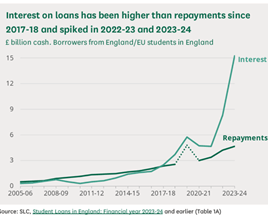
      Higher interest rates, particularly those implemented from September 2022, have sharply increased the burden of student debt. Interest added to outstanding loans soared to £8.3 billion and £15.3 billion in 2023-24 alone. In the latest year, the interest capitalised on student debt was three times the value of repayments made—demonstrating how repayments are failing to keep pace with even the cost of borrowing, let alone reducing the principal.-

      Advertisements

      By the min 2040’s, the government estimates this to rise to over £500 billion in today’s money. The truth that be simply taking an adjustment of 2,5% inflation, the tru figure will be in excess of £800 billion and I would expect this to be £1 trillion.

      Government Accounting and Debt Structure

      Current government accounting methods do not show the full scale of student loan costs within annual expenditure figures. Instead, these liabilities are largely kept off the balance sheet, appearing instead as a growing component of government debt and accruing interest payments.

      As of now, out of the UK’s £2,800 billion national debt, approximately £266 billion—or nearly 10%—is attributable to student loans. This means the annual interest on student debt alone is close to £10 billion (based on a 10% share of a £105 billion interest bill). Crucially, the total repayments from former students do not cover even this interest, let alone reduce the outstanding capital.

      Advertisements

      Long-Term Concerns

      This imbalance raises serious questions about the sustainability of the system. With current interest rates and repayment levels, a significant number of borrowers will never fully repay their loans. Inevitably, a large portion of this debt may have to be written off or absorbed by taxpayers in future—i.e. the very taxpayers who may have taken out student loans themselves.

      Proposed Solutions

      • Lower Student Loan Interest Rates: Align student loan rates with the Bank of England (BoE) base rate and retroactively recalculate past interest charges. Charging higher rates than the government itself can borrow at is neither fair nor economically rational.
      • Make Extra Payments Tax-Deductible: Allow any voluntary extra repayments to be deducted from taxable income. This would incentivise early repayment, especially among higher earners, and could, with a 50% take-up rate, add £5–10 billion annually to debt reduction efforts.
      • Simplify Earnings Thresholds: Introduce a uniform minimum earnings threshold of £25,000 for all borrowers, replacing the current array of thresholds which complicate repayment planning and administration.

      Assumptions and Next Steps

      This analysis is based on available public data, with some necessary assumptions regarding the average outstanding loan size and average age of borrowers. These figures will be refined as more information becomes available.

      Conclusion

      The current UK student loan system is unsustainable under present conditions. Without reform, the rising tide of student debt will eventually return to the public purse, impacting not just graduates but the entire taxpaying population. The proposed measures offer a starting point for meaningful change, with the aim of building a fairer and more financially robust system for future generations.

      Feedback and further suggestions are welcome—this is an issue that demands urgent and informed public debate.